
Welcome to the new PPA market paradigm
PPA pricing has fallen from record highs but will not revert to pre-crisis levels. Rising demand, constrained project supply and higher CfD bids have set a new floor under contracted rates.
Introduction
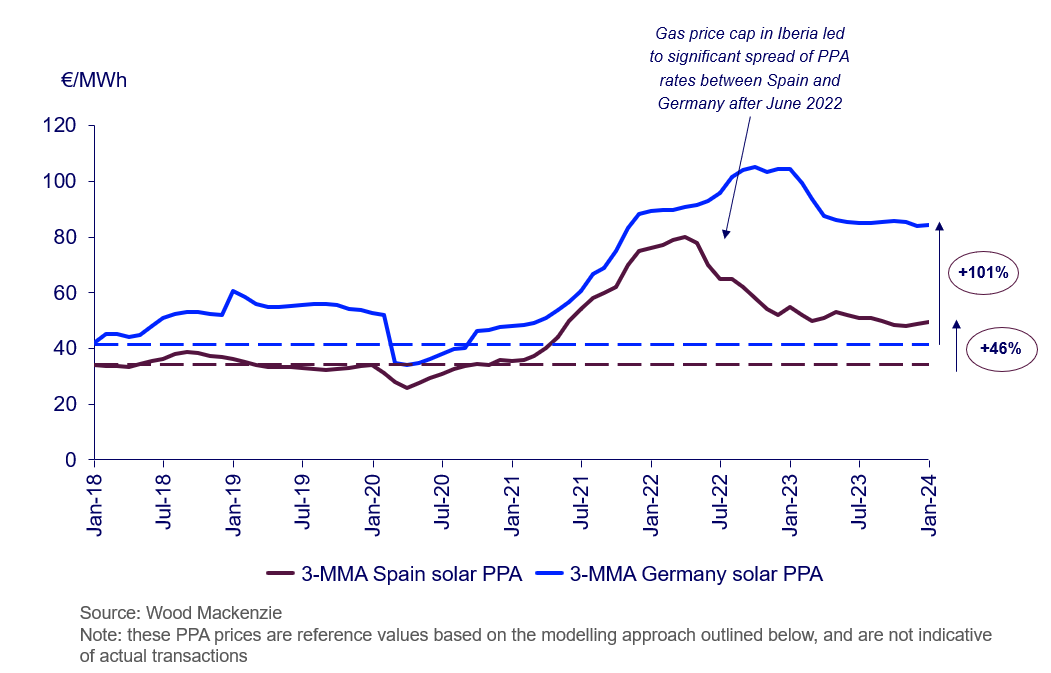
Power markets have experienced exceptional volatility in recent years, and power purchase agreement (PPA) prices have moved with them. Contracted rates have retreated from their peaks as concerns over European gas shortages eased, but they remain above the levels seen before the energy crisis. A return to those historical benchmarks is unlikely in the short to medium term. Demand for renewable procurement continues to expand, grid constraints are limiting the supply of viable projects, and supply-chain inflation has pushed contract for difference (CfD) bids higher, lifting the minimum price many developers will accept for a PPA.
For buyers, the conclusion is that waiting indefinitely for a further fall in prices carries risk, especially as sustainability obligations become more demanding. Some asset owners may gain from delaying a contract until forecast equipment-cost reductions improve project returns. In markets facing severe grid congestion and curtailment, however, sellers may need to act sooner. These competing pressures define the new PPA market paradigm.
What makes up a PPA price?
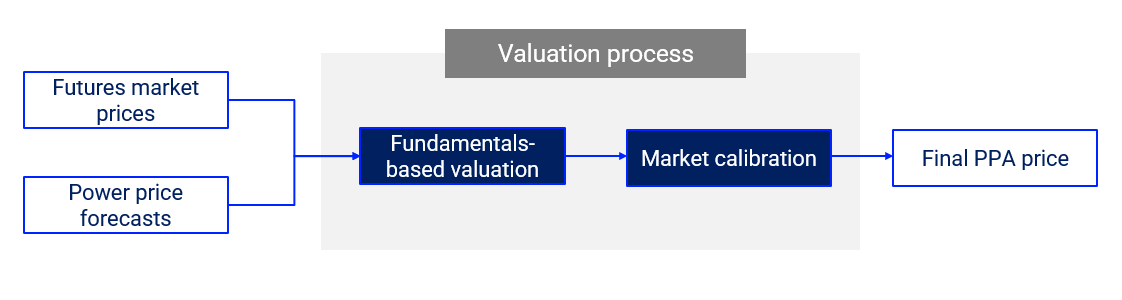
A PPA price ultimately reflects supply and demand, although negotiations commonly begin with a benchmark. A fundamentals-based valuation can establish that reference point using futures curves and long-term power-price forecasts. The calculation then incorporates prevailing baseload prices, guarantees of origin (GoOs), the discount associated with the generation profile, price risk and balancing costs.
The resulting reference value must then be adjusted to reflect current market conditions. Relevant considerations include how many projects are actively seeking corporate offtakers, the cost of developing those assets, the clearing prices available through alternative routes to market such as European CfD auctions, and the level of corporate demand in each country. It can take several months of negotiation before counterparties converge on a final contracted price.
While wholesale levels have fallen, GoO prices have supported asking rates
Over the long term, lower renewable technology costs and a rising share of clean generation should place downward pressure on PPA prices, provided investment in transmission and distribution keeps pace. The nearer-term outlook is different, with contracted prices more likely to remain broadly stable.
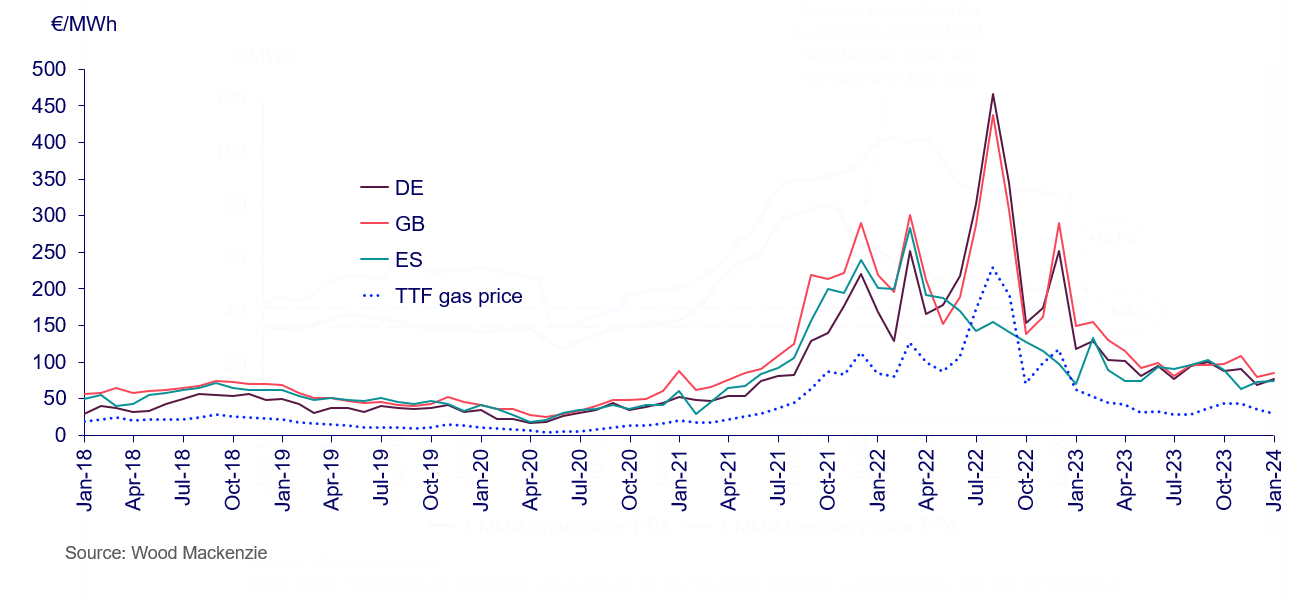
Although wholesale prices have declined from recent highs, European baseload prices may still experience sharp increases as power systems absorb rapidly growing renewable output without equivalent gains in grid flexibility. Unless electricity-market design changes materially, gas is also likely to retain an outsized influence on marginal power prices, even as its share of total European generation falls.
Greater price cannibalisation will deepen shaping discounts and weigh on renewable PPA values. This effect is partly balanced by the value of GoOs. Certificates that traded at around €1/MWh before the crisis approached €10/MWh in major European markets in early 2023. Prices have since softened, but tighter EU sustainability disclosure rules should provide support. Demand for 24/7 renewable procurement and real-time certificate matching may strengthen that value further. Lower wholesale-price risk and reduced balancing costs also underpin PPA pricing as volatility recedes from the levels seen after Russia's invasion of Ukraine.
Ever-increasing demand keeps a floor under prices
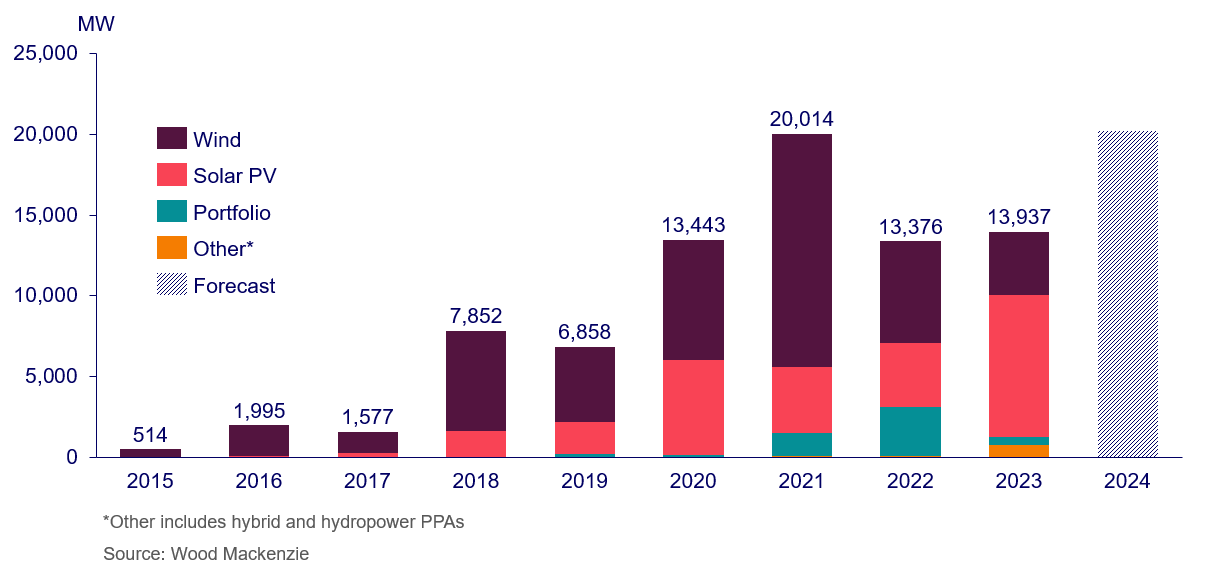
Strong demand is another reason that PPA prices are unlikely to revisit pre-crisis levels soon. Corporate procurement fell in 2022 amid extreme uncertainty and market volatility, but contracted volumes recovered to almost 14 GW in 2023. Activity is expected to continue expanding, with annual corporate demand returning to record territory at more than 20 GW of contracted capacity.
Corporate climate commitments are encouraging more businesses to secure renewable PPAs. Regulation is reinforcing that trend. The EU Corporate Sustainability Reporting Directive introduces new requirements to disclose sustainability impacts and risks, affecting an estimated 50,000 European companies. These obligations should stimulate additional procurement among businesses seeking to improve their reported performance, while comparable measures are expected in the UK.
The tariff shocks that followed Russia's invasion of Ukraine also made price certainty and hedging strategic priorities for company executives. PPA interest has risen most sharply among businesses where energy represents a large share of operating costs. When power and gas prices surged in 2022, some smelters, chemical plants and other energy-intensive facilities stopped operating. More such businesses are likely to use renewable PPAs to reduce the risk of future shutdowns.
Data centres, already an important source of PPA demand, should add further momentum. Some countries have begun linking new data-centre licences to the existence of renewable energy contracts. Between 2015 and 2023, European technology offtakers signed more than 8 GW of PPAs, equal to roughly 17% of total procurement. Credit-guarantee and aggregation schemes encouraged by the EU Electricity Market Reform should broaden the buyer pool further during this decade.
Elevated project costs and constrained supply support valuations
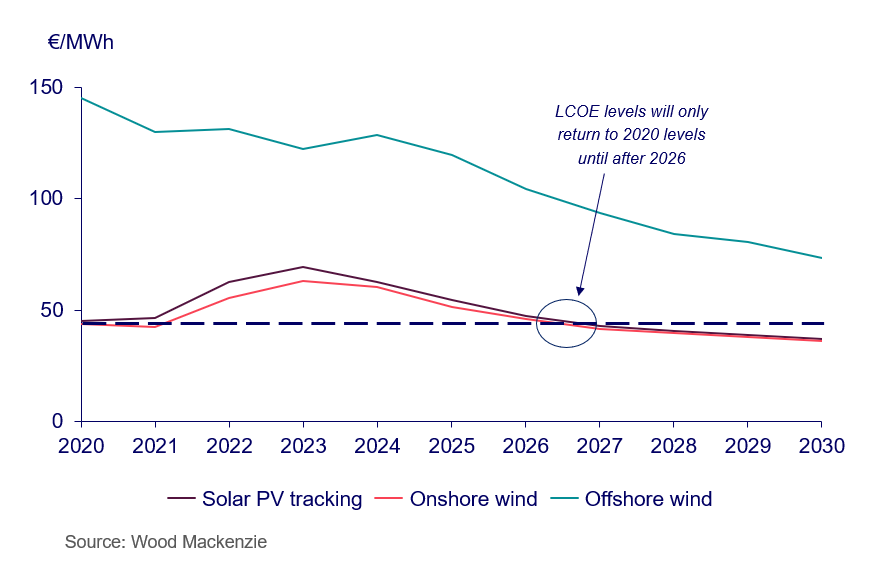
Supply conditions also support higher valuations. Disrupted supply chains and more expensive finance have increased project costs and, in turn, developers' minimum asking prices. Copper, steel and other important renewable-energy inputs became more expensive, while the European Central Bank's policy rate rose from 0% in 2020 to 4.5%. Between 2020 and 2023, levelised costs increased by 54% for tracking solar PV and 44% for onshore wind. These technologies are not expected to return to their 2020 cost levels until after 2026, keeping a floor under PPA offers in the short term. Sellers seeking a wider margin between construction costs and contracted revenues could therefore wait, although deteriorating conditions in some markets may make delay impractical.
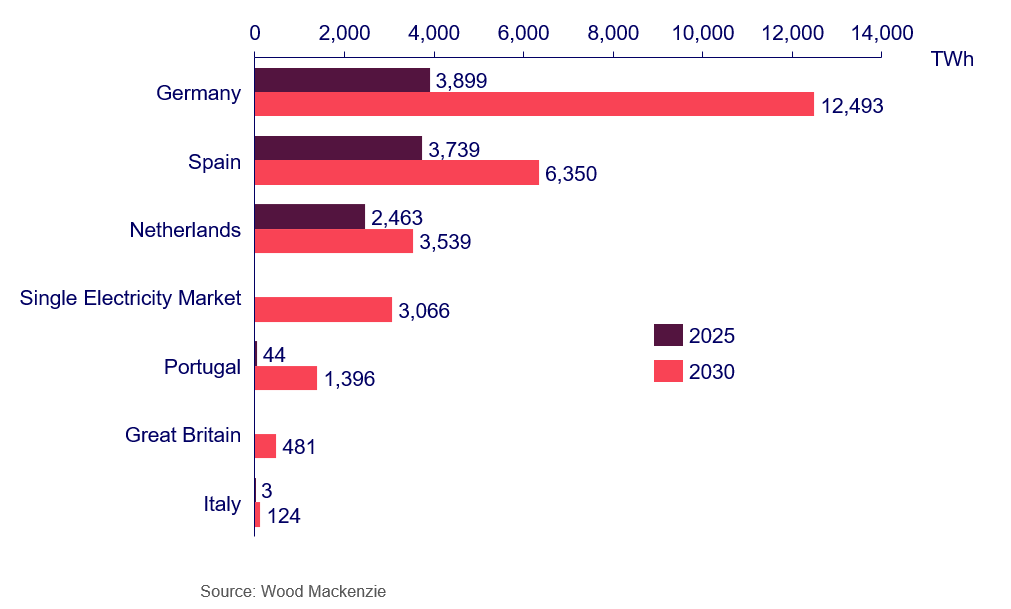
Grid bottlenecks are restricting the volume of PPA-backed capacity that can enter operation across Europe. Curtailment is rising as solar and wind gain share faster than networks can accommodate them, weakening project economics and discouraging development. Spain has experienced particularly severe capture-price erosion: monthly solar PV capture rates fell to only 65% of the average market price in April 2023. Contracted Spanish solar PPA volumes then dropped to a combined 960 MW in the second and third quarters of 2023, compared with 1.3 GW in the first quarter alone, as buyers and sellers reassessed conditions. The situation reportedly deteriorated again in February 2024, and the number of zero-price hours recorded during the year had already exceeded the previous year's total. Until electricity demand, battery deployment and interconnection capacity catch up with renewable generation, some developers may avoid the most exposed markets.
CfD auctions across Europe offer developers alternative routes to market
Competitive auction outcomes also influence the prices developers seek in corporate contracts. European wind and solar projects generally rely on one of three commercial models: merchant exposure, government CfDs or PPAs. Fully merchant projects remain a small share of delivery because their revenues are uncertain and difficult to finance, leaving CfD auctions and PPAs as the two practical options for most developers.
CfDs are comparatively low risk because they often run for around 15 years and are effectively supported by a government offtaker. Developers are therefore reluctant to accept a PPA price below the available CfD level, particularly because corporate PPAs can present greater risk to both sponsors and lenders and consequently require a premium over auction clearing prices.
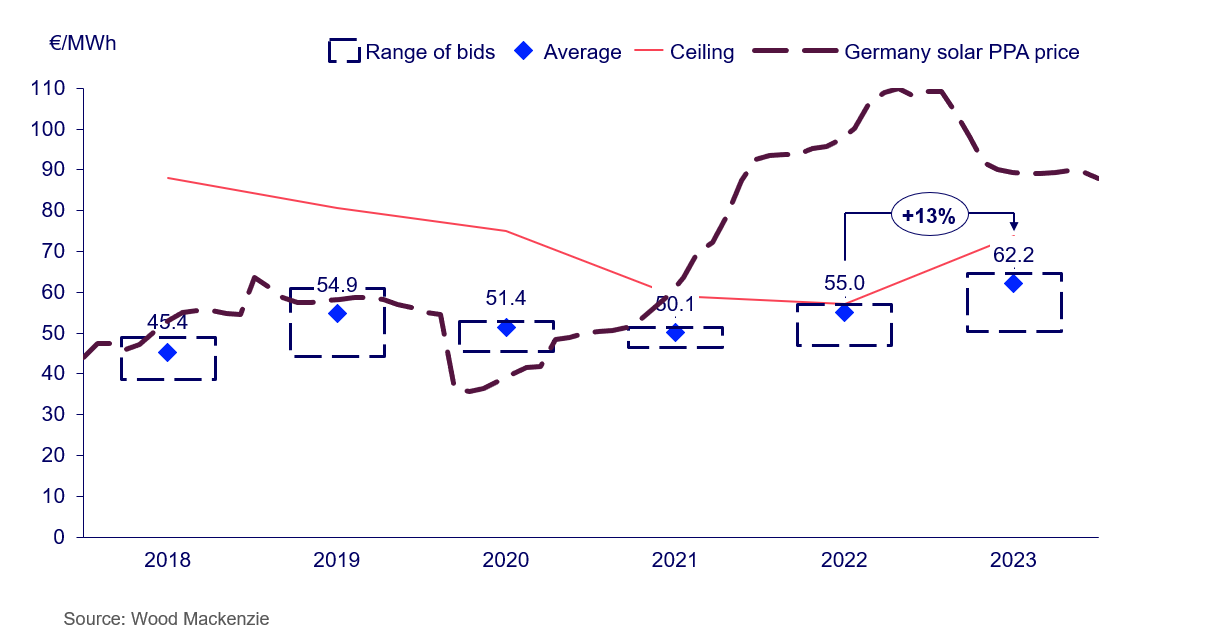
Supply-chain inflation has also lifted both average and maximum bids in European CfD tenders. In Germany, the average solar PV auction rate increased by 13% between 2022 and 2023, while the ceiling rose by 29%. The 2023 average bid of roughly €62/MWh was almost equal to the German solar PPA reference price recorded in 2021. Meaningful downward pressure in PPA negotiations will be difficult while CfD prices remain elevated.
Conclusion: do not expect PPA prices to fall much further
Buyers should not wait indefinitely before signing deals
The retreat from peak PPA prices and the reduction in volatility will be welcome news for buyers securing contracts at lower levels. Executives at corporate and industrial companies who are still postponing procurement in anticipation of another substantial fall, however, may be waiting for a move that does not arrive.
Growing demand and a constrained pipeline of financeable projects have fundamentally changed the market. In several countries, the balance has shifted decisively towards sellers, reversing the conditions of earlier years. Higher CfD auction bids give developers little incentive to make large concessions in PPA negotiations. Contracted prices are therefore likely to move broadly sideways and remain above pre-crisis benchmarks for the foreseeable future.
Sellers should move quickly in markets facing severe cannibalisation
For asset owners, waiting may still be beneficial where falling equipment costs are expected to improve returns. The calculation changes in markets exposed to heavy curtailment and price cannibalisation, where the supply of viable PPA projects could contract quickly. Spain already provides evidence of this shift, with some domestic developers expanding abroad in search of stronger economics.
Whether you are buying or selling, timing and structure now matter as much as price. Our corporate PPA advisory helps offtakers benchmark offers and negotiate terms, and our commercial due diligence for renewable assets helps sellers and investors understand merchant and cannibalisation exposure. To discuss a live procurement or transaction, get in touch with KlaraVolt.
Keep reading
Latin America's Data Centres Will Skip Europe's PPA Mistakes
Latin America's data centre operators can learn from Europe's PPA market and move directly towards hybrid, baseload-like structures that better match round-the-clock power demand.
Why PPA adoption is accelerating in Latin America
Latin America has lagged Europe and the US on corporate PPAs despite abundant resources. Market liberalisation, hydropower volatility and currency de-risking are now changing that.