
Latin America's Data Centres Will Skip Europe's PPA Mistakes
Latin America's data centre operators can learn from Europe's PPA market and move directly towards hybrid, baseload-like structures that better match round-the-clock power demand.
AI training and inference demand is driving global data centre capacity expansion, including in Latin America. This acceleration, however, is now running into supply constraints, notably power. Data centres are now contracting directly with renewable developers through power purchase agreements (PPAs) and other structured energy products.
How these contracts are structured, however, matters. In Europe, hyperscalers led the first wave of corporate PPAs, mostly on a pay-as-produced basis. When renewable buildout outpaced expectations though, the economics of many of these deals worsened. The market is now moving up what I call the 'PPA Procurement Maturity Curve', towards hybrid and more baseload-like structures.
While Latin America's PPA volumes remain well below Europe's, key markets already see high levels of renewable curtailment, a symptom of the same renewables oversupply. Rather than repeat Europe's cycle, however, Latin America is set to leapfrog it and move straight to more baseload-like PPAs. Operators that secure these instruments early will be better protected against volatile power prices and tightening sustainability-accounting rules.
The data centre landscape in Latin America
Surging data centre buildout
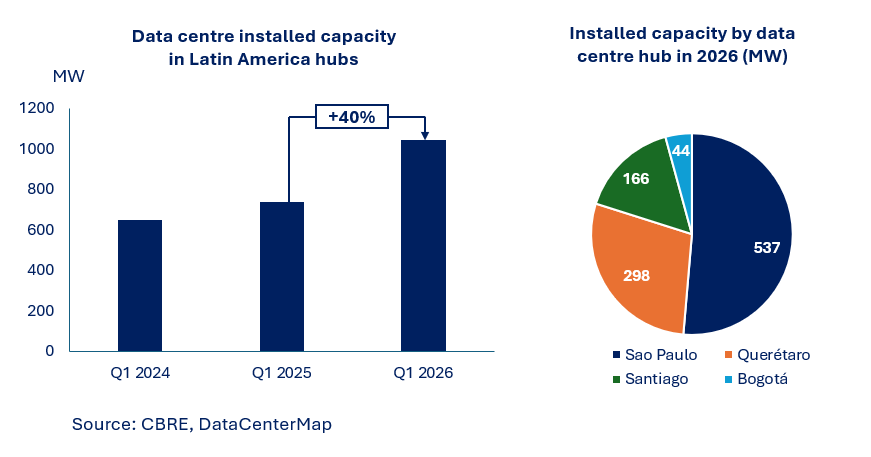
Data centre announcements across key markets in Latin America have surged in recent years. Installed capacity in the main hubs of Latin America (São Paulo, Querétaro, Santiago, Bogotá) rose 40% year-on-year to reach over 1 GW of capacity by early 2026. Brazil in particular is seeing aggressive commitments from international players; ByteDance's campus investment in Ceará will reportedly total more than R$200bn (c. US$38bn).
Power procurement is becoming the strategic question
This data centre buildout, however, brings a specific kind of energy demand. Data centres run large, high-utilisation loads that stay relatively flat around the clock. How operators source that power, and in what shape, is becoming as strategic as where they build.
Increasingly, the answer is PPAs. ByteDance's Ceará campus is set to be supplied under a 20-year PPA from the 630 MW Ibiapaba wind complex. In Brazil, regulation is reinforcing the trend where the REDATA tax regime makes its incentives conditional on data centres sourcing all their electricity from renewable sources. Tight grid connections in the main hubs, with lead times reportedly reaching 36 months in São Paulo, are adding to the pressure to secure dedicated supply early.
The question is no longer whether data centres in the region will sign PPAs, but what kind. That choice is where Latin America is set to diverge from Europe.
Lessons from Europe
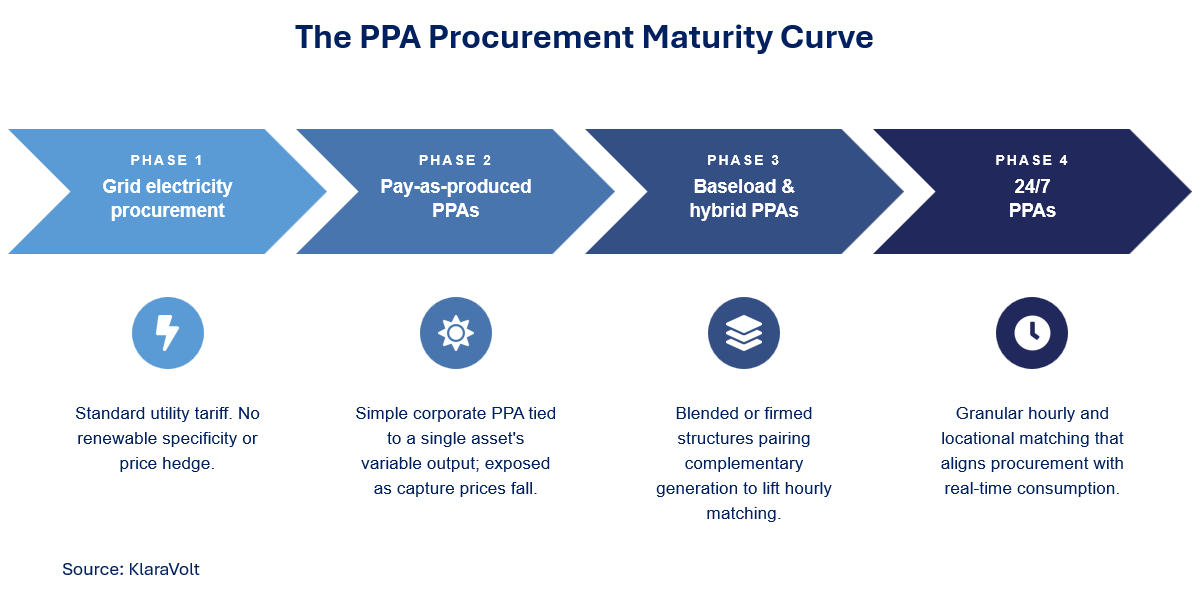
The PPA Procurement Maturity Curve
As a power market matures and liberalises, large energy consumers (such as data centres and heavy industrials) typically move up the 'PPA Procurement Maturity Curve', driven by economic and sustainability considerations.
In Phase 1, consumers buy electricity on short-term retail grid contracts, with no renewable specificity or price hedge. In Phase 2, they sign their first PPAs to reduce Scope 2 market-based emissions and hedge energy costs, typically through pay-as-produced deals tied to the variable output of a single asset. Phase 3 brings baseload and hybrid structures, which pair complementary generation to shape supply closer to a load profile. Phase 4 is 24/7 procurement: hourly and locational matching of clean supply to real-time consumption.
Europe went all-in on Phase 2, and then it broke
Europe followed this path. Data centre operators and the hyperscalers pioneered the uptake of PPAs here, kickstarting the PPA-financing boom. Most started with pay-as-produced structures due to their relative contractual simplicity and ability to finance new renewable projects.
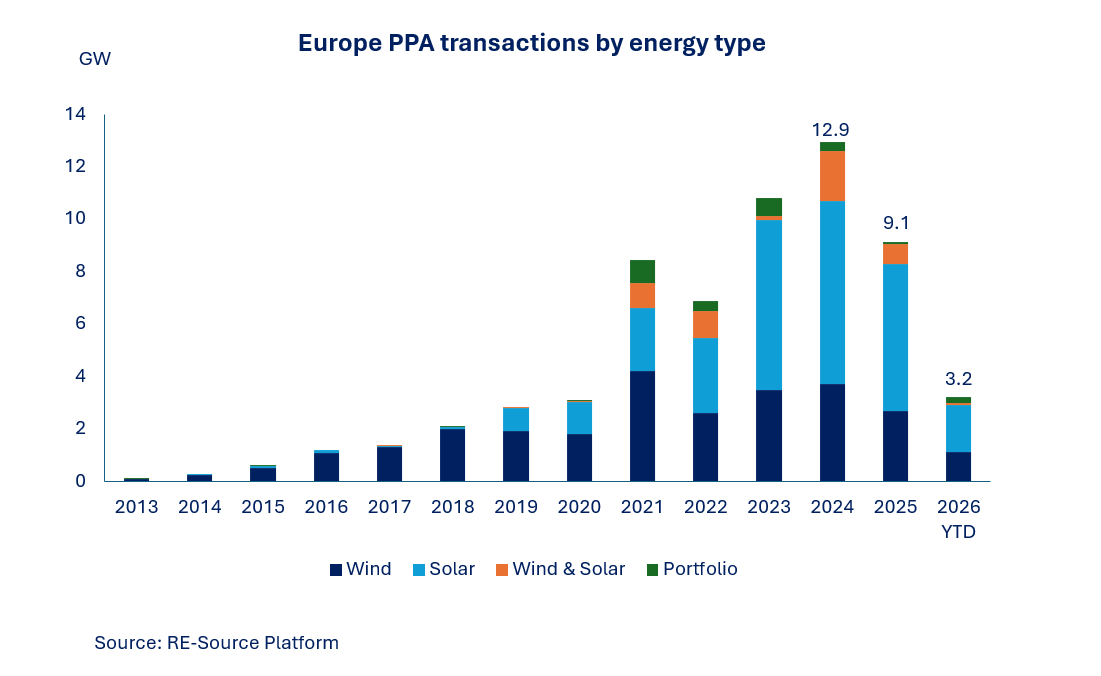
Pay-as-produced PPAs have not, however, always been economical for buyers. As renewable buildout outpaced market expectations in Europe, capture prices fell and original NPV assumptions behind many 'contract-and-forget' pay-as-produced deals no longer held. Too much volume and price risk had been placed on the buyer in many cases, and demand for simple pay-as-produced structures has since fallen sharply. European PPA volumes fell year-on-year from 12.9 GW to 9.1 GW in 2025, according to RE-Source, and 2026 looks likely to continue the downward trend.
Europe is now moving up to Phases 3 and 4
In response, European buyers are moving up the Curve. Phase 3 baseload and hybrid PPAs are gaining traction as a way to reduce volume and price risk. At the same time, proposed revisions to GHG Protocol and SBTi guidance are also pulling the market towards Phase 3 and 4. As standards move toward hourly matching and locational requirements, pay-as-produced instrument look increasingly out of step.
The market signal is clear: corporates want load-shaped PPAs that shift some of the volume and price risk back towards sellers.
Why Latin American data centres will largely skip the pay-as-produced PPA phase of the maturity curve
Curtailment is already surging
Even as power markets in Latin America become increasingly liberalised, data centre operators are unlikely to spend long in Phase 2 of the PPA Procurement Maturity Curve. In Europe, the flaws of pay-as-produced models only surfaced after the model had been tested and scaled. In Latin America, the evidence of those flaws is already visible even before mass PPA adoption.
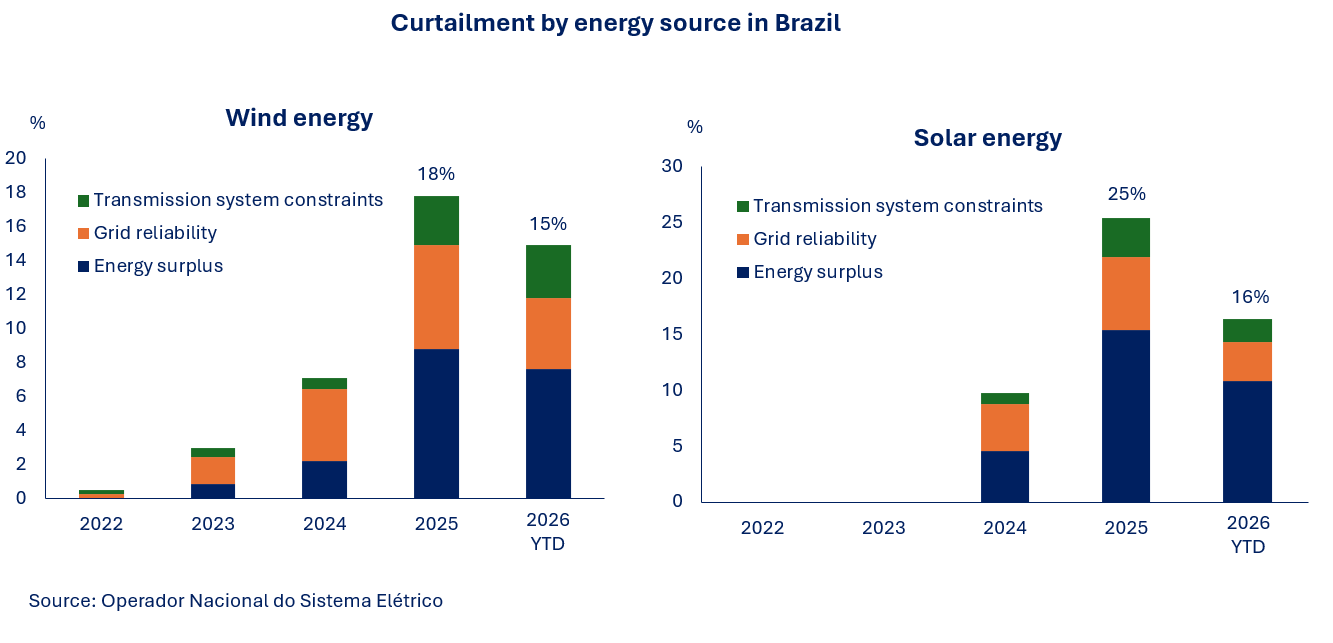
Renewables oversupply, and the curtailment it causes, is the clearest signal. Brazil illustrates the problem, where average annual wind curtailment rose from under 1% in 2022 to around 18% in 2025. Solar curtailment peaked at around 25% the same year. Both remain well above 10% in 2026 to date.
Solar pay-as-produced fits a data centre's load poorly
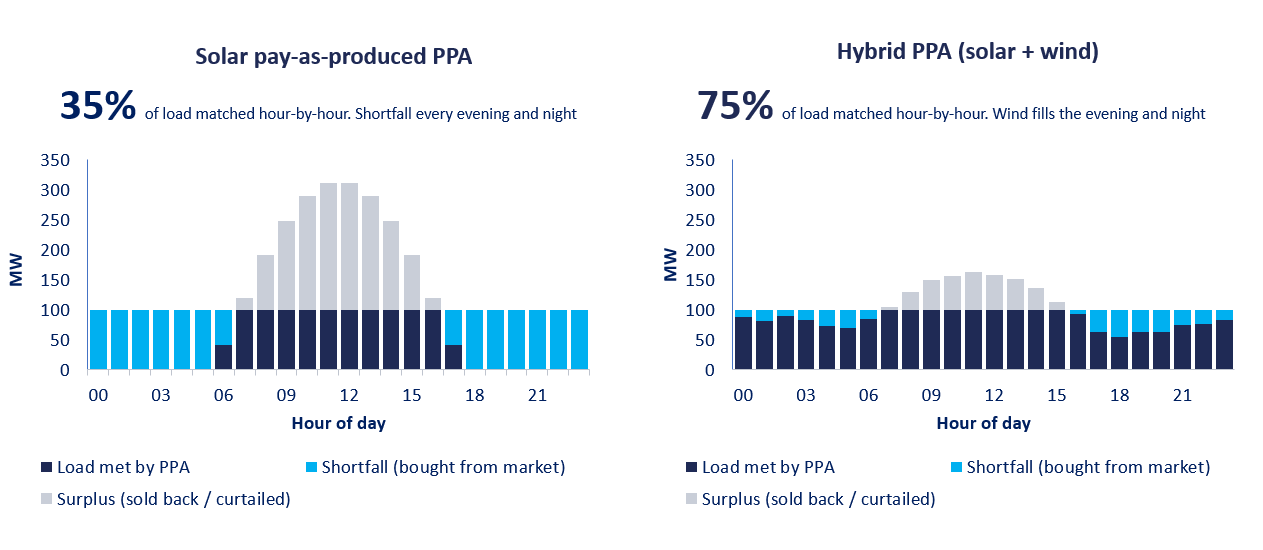
Under a pay-as-produced PPA, the buyer takes whatever the asset generates and buys any shortfall from the market. This volume mismatch is particularly pronounced for solar pay-as-produced deals. Output peaks around midday, exactly when renewable supply is highest and prices are lowest. The shortfall falls in the evening, when prices are highest.
This matters because data centres run high-utilisation loads that stay relatively stable around the clock. As a result, operators are looking to more hybrid and baseload-like PPA structures which will reduce the volume mismatch and hours exposed to market prices. If structured correctly, a hybrid PPA can lift the hourly load matching ratio to ~75%, compared to ~35% for a solar deal.
Early deal flow already points away from solar-only deals
The shift is still early. However, wind and hybrid deals have accounted for a large share of recent transactions. Crucially, Latin America operators do not yet have a large installed base of pay-as-produced deals to unwind, so there is little to slow the move towards more baseload-like structures in the coming years.
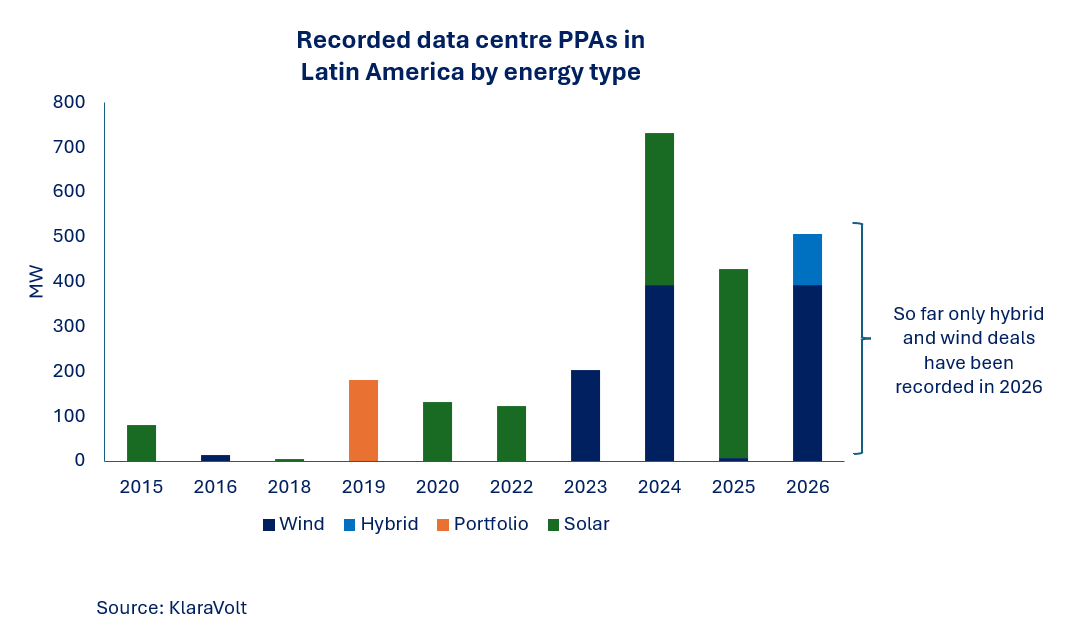
In effect, the market is starting where Europe finds itself after a decade of course-correction. Developers structuring new Latin American projects are already underwriting for locational and hourly considerations that have only recently become central to European deal-making.
What this means for data centre operators and developers
Data centres in Latin America need power quickly, and PPAs are becoming central to their procurement strategy. Fortunately, operators have an advantage that Europe's early movers lacked. The warning signs, namely surging renewables curtailment, are visible before the PPA market has really taken off.
For operators, the headline PPA price is the wrong place to start. The more useful questions are how much of the site's hourly load the contract actually covers, who bears curtailment risk and what supplies the profile. A hybrid or baseload product will usually carry a higher contract price, but the comparison that matters is total cost once shortfall purchases and residual price risk are included.
For developers, the ability to offer a shaped product is becoming a competitive differentiator. The flipside is that shaped products shift volume and price risk back onto the seller. Developers will need to value that risk properly and reflect it in their pricing, rather than passing it straight through to the buyer.
Getting the contract shape right requires a clear view of hourly load, grid constraints and market rules. KlaraVolt provides PPA structuring and advisory for data centre operators, and commercial due diligence on renewable assets for developers and investors backing new capacity. Talk to us about your project.
Keep reading
Why PPA adoption is accelerating in Latin America
Latin America has lagged Europe and the US on corporate PPAs despite abundant resources. Market liberalisation, hydropower volatility and currency de-risking are now changing that.
Unlocking renewable energy financing in emerging markets
Over 1 TW of solar, wind and BESS is set to be built across emerging markets by 2030, worth USD 1.3 trillion. Getting it financed depends on green bonds, blended finance and the right de-risking tools.