
Unlocking renewable energy financing in emerging markets
Over 1 TW of solar, wind and BESS is set to be built across emerging markets by 2030, worth USD 1.3 trillion. Getting it financed depends on green bonds, blended finance and the right de-risking tools.
Executive summary
Renewable energy is central to the global response to climate change. Its importance is especially pronounced in emerging markets, where industrial expansion and population growth are rapidly increasing electricity demand. In this article, 'emerging markets' refers to developing regions expected to add substantial renewable capacity in the coming years, including Latin America, the Middle East, Africa, Eastern Europe and developing Asia.
These markets have an opportunity to move beyond conventional fossil fuel systems and build cleaner energy infrastructure from the outset. Yet renewable projects in these regions can be difficult to develop and finance, with elevated risks discouraging many international participants. The scale of the opportunity remains considerable, and innovative financing structures will be essential to unlock it.
This article examines the forces shaping renewable energy finance across emerging markets. It considers the size of the investment opportunity, the principal barriers, the institutions active in the sector and the tools available to reduce risk. Investors and developers that can move decisively while managing those risks stand to capture significant value.
A US$1.3 trillion renewables investment opportunity awaits this decade
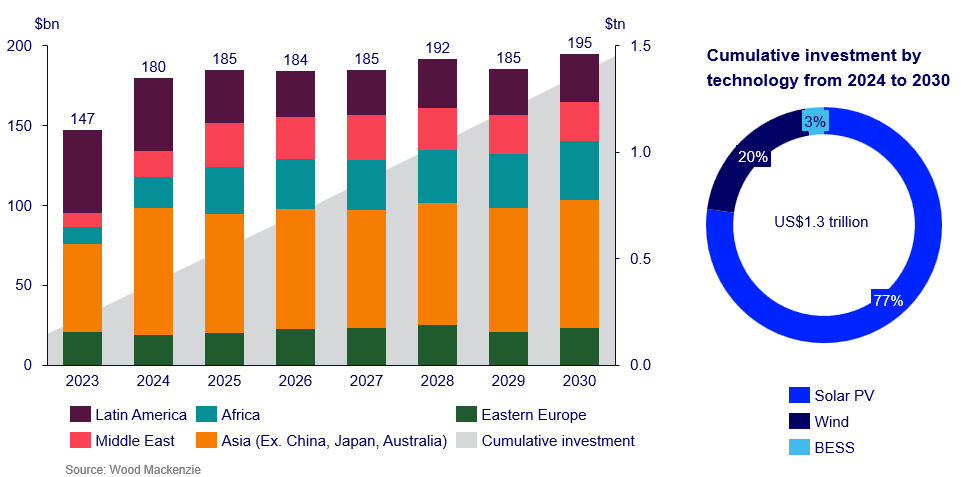
The financing opportunity for low-carbon power in emerging markets is vast. Current development and installation plans indicate that more than 1 TW of solar, wind and battery energy storage system (BESS) capacity could be built between 2024 and 2030 across Latin America, Eastern Europe, the Middle East, Africa and developing Asia. That pipeline represents about US$1.3 trillion of cumulative investment. Solar PV accounts for roughly US$1 trillion of the total, supported by its low levelised cost of energy and modular design. Stronger policy incentives could draw in additional capital, accelerate deployment and support deeper emissions reductions.
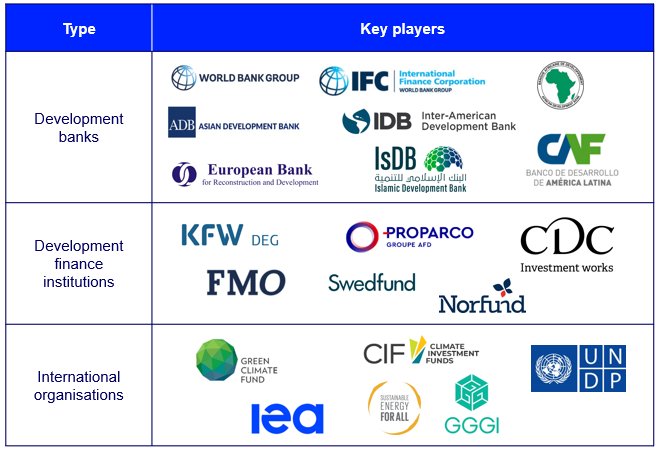
Even with this substantial investment potential, many investors remain cautious. Development banks, development finance institutions (DFIs) and international organisations therefore tend to lead activity in these regions, ahead of private capital providers and renewable energy developers.
These institutions are mandated to close financing gaps while advancing economic development, poverty reduction and sustainability. The International Finance Corporation's Scaling Solar initiative¹ is one example. By offering standardised financial, legal and technical support, the programme has helped mobilise private capital for competitively priced, grid-connected solar projects in Africa.
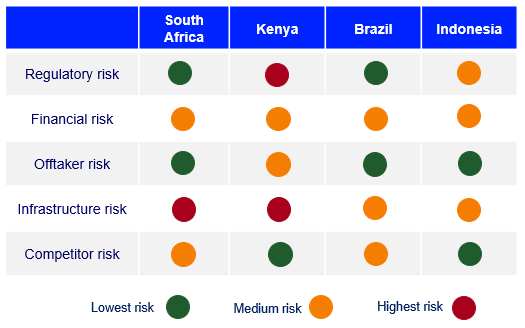
Suspension of PPA contracts is just one of the key risks in emerging markets
For some investors, the risk profile can outweigh the otherwise compelling opportunity.
Political and regulatory instability is a primary concern because it can produce sudden policy reversals and undermine financing assumptions. Changes in government, political pressure, lobbying by incumbent interests and wider macroeconomic stress can all alter renewable energy rules. Kenya illustrates the issue. From 2021 to 2023, the government paused new power purchase agreements (PPAs) as it sought to contain inflation-driven increases in retail electricity prices. The suspension introduced a clear warning signal for investors evaluating project finance and acquisition opportunities in the country.
Physical and institutional constraints add further complexity. Weak grid infrastructure can delay projects and increase the cost of new transmission, while shortages of skilled workers and restrictive market structures can slow development. Financial exposure, offtaker credit quality and competitive pressure also need to be assessed.
Managing these issues requires robust risk controls, supportive public policy and international financial backing. In some cases, projects have proceeded only after a development bank or DFI intervened. Private investors and developers may wait until one of these institutions has absorbed or mitigated part of the risk before committing capital.
¹ https://www.scalingsolar.org/
Lack of capital markets and exchange rate volatility make access to financing difficult
Renewable energy projects are generally funded through equity, debt or a combination of the two. Equity financing gives an external investor an ownership stake in exchange for capital, but meaningful access to deep equity markets is limited to a relatively small group of developers. Some projects are funded directly from a sponsor's balance sheet, although this option is usually confined to well-capitalised utilities, energy majors and infrastructure funds.
Debt finance typically takes the form of loans or bonds that are repaid over time, with project assets and contracted revenues supporting the borrowing. Pricing varies sharply between countries because lenders assess each market differently. For renewable projects in emerging economies, debt costs can be two to three times those seen in developed markets.
Lenders will usually require a long-term revenue contract, such as a corporate or government-backed PPA or contract for difference (CfD), before providing debt. International financiers and developers may also insist that payments are made in dollars or euros, or that an effective currency hedge is available, because exchange-rate swings can materially alter project returns. An investment-grade offtaker is commonly expected to reduce default exposure, yet such counterparties are scarce in many emerging markets. Access can be constrained further when domestic lenders have limited sector expertise.
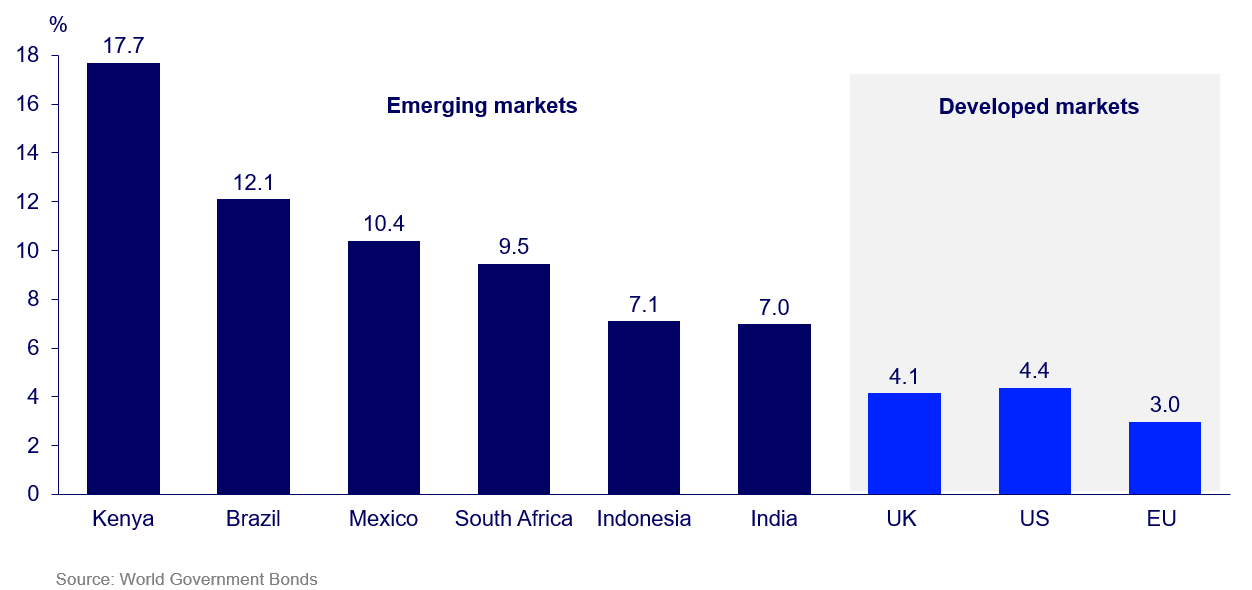
Restricted access to bond, equity and broader capital markets pushes up the weighted average cost of capital (WACC) for renewable developers in emerging economies. Sponsors may have to rely on higher-rate local bank debt or private equity seeking substantial returns. The limited depth and range of financial instruments also increases perceived risk, making both debt and equity more expensive.
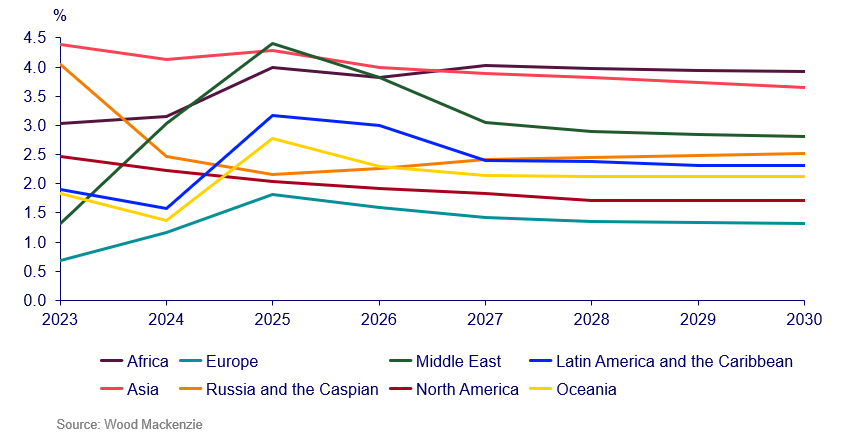
Although WACC levels declined slightly this year, the gap with developed markets remains wide. Over time, more supportive policy, deeper domestic capital markets and stronger risk-mitigation mechanisms should help narrow it.
Green bonds are driving capital to developing markets
Given the financing constraints and elevated risk, some capital providers have avoided renewable projects in emerging markets altogether. Regulatory uncertainty, weak offtaker credit, limited developer track records, inflation, infrastructure gaps and currency volatility can all raise red flags. At the same time, subsidies and incentives in the US and EU may make projects in those established markets appear more attractive.
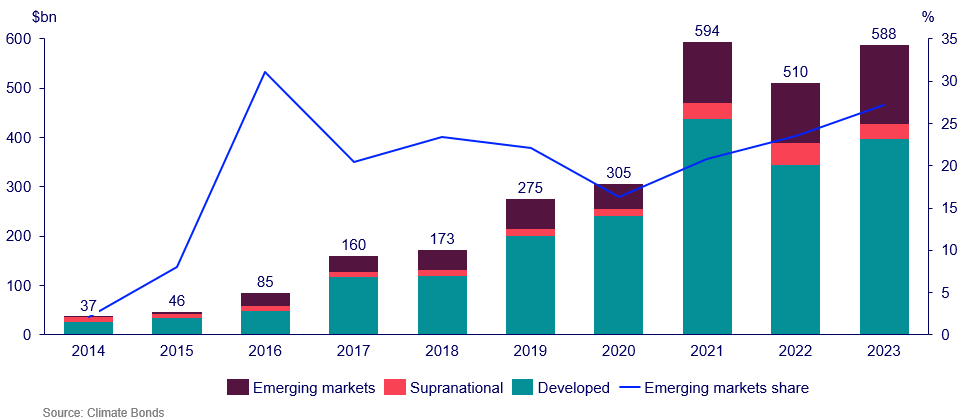
A range of financing models has emerged to overcome illiquidity and move viable projects towards completion. Green bonds, blended finance, pay-as-you-go structures and crowdfunding all broaden access to capital. Green bond issuance alone increased from approximately US$40 billion in 2014 to almost US$600 billion in 2023. Emerging-market activity has also taken a larger share of the market since 2020, reaching 27% of issuance in 2023.
Crowdfunding is another expanding source of finance. These platforms open renewable projects to smaller investors, allowing individuals to participate in and benefit from the energy transition. They can be especially useful in emerging markets where conventional funding channels are limited. Several specialist businesses now serve this segment, including Swedish company Trine², which supports solar development in areas such as sub-Saharan Africa.
² https://trine.com/
Blended finance and public-private partnerships (PPPs) provide a further way to reduce investment risk. By combining the different capabilities of government and business, these structures can mobilise capital for renewable projects while supporting wider development goals.
Public-sector participants may establish the regulatory framework, facilitate land acquisition and provide funding or guarantees that lower risk for private investors. Private partners can then contribute capital and technical capability, helping projects progress more quickly. Jordan's 117 MW Tafila Wind Farm demonstrates the model. A private consortium including Masdar and EP Global Energy developed the project with financing and support from the IFC, European Investment Bank and OPEC Fund for International Development. Guarantees, other risk-mitigation measures and a government-backed PPA were central to the financing package.
PPAs and currency hedging are important de-risking tools
New sources of capital are only part of the solution. Investors and developers must also control risks that can undermine project economics, particularly uncertain revenues and volatile exchange rates. PPAs and currency hedges are among the most important tools available.
A PPA usually fixes or stabilises project revenues for 10 to 25 years, reducing exposure to market prices and improving bankability. That certainty is particularly valuable where regulatory and market conditions are less predictable. Corporate PPA activity has grown quickly as industrial companies seek both decarbonisation and energy-cost protection. In emerging markets, however, investment-grade offtakers can be difficult to find, and the power market must generally be liberalised before private contracts are possible.
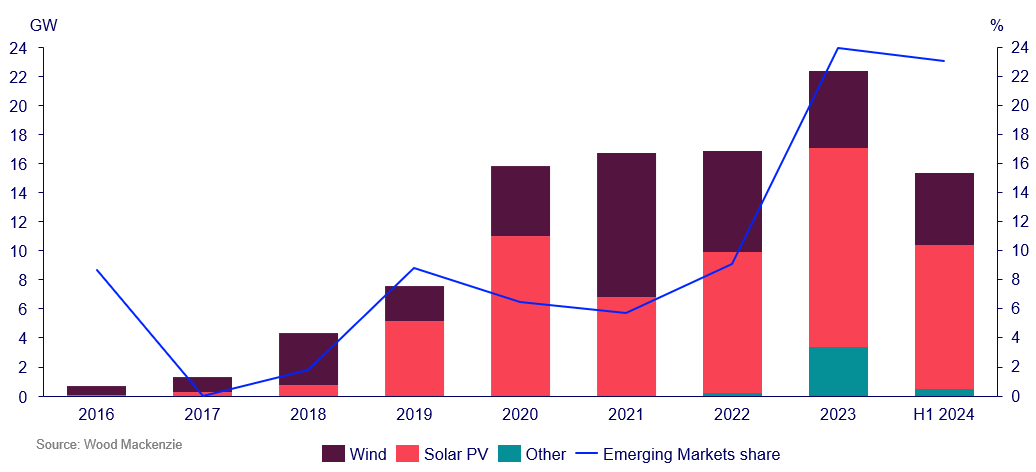
As domestic financial systems mature and multinational companies decarbonise their operations, PPA procurement should continue to expand. Emerging markets already accounted for a record 24% of global corporate PPA activity in 2023.
Currency hedging can also determine whether an emerging-market project is financeable. Capital expenditure is often funded by international investors in dollars or euros, while the project earns revenue in a local currency that may depreciate or fluctuate sharply.
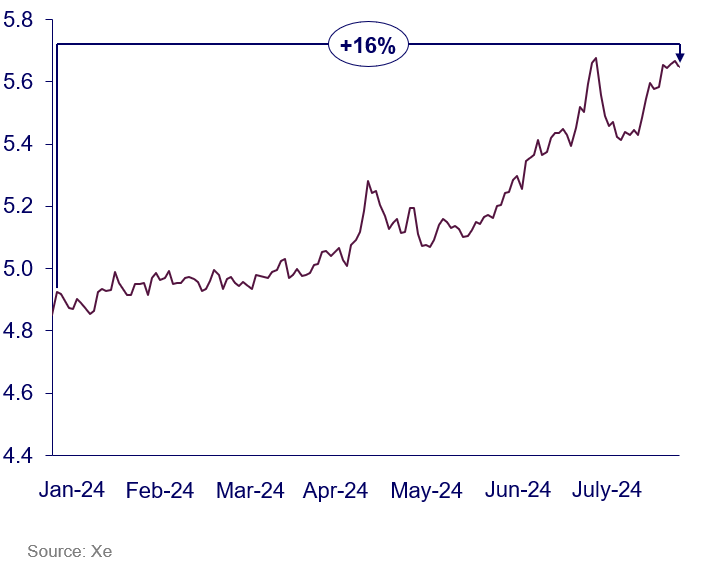
Forward contracts and options can lock in an exchange rate or provide insurance against an adverse move. This lowers uncertainty and the associated risk premium, improving the proposition for international lenders and investors. Consider a Brazilian wind operator using a put option to convert reais into dollars at an agreed rate. Such protection would have offset an approximately 16% fall in the real that year. Without the hedge, currency movements on a 10 MW project with close to US$17 million of capital expenditure could have produced a loss of roughly US$2.7 million if equipment had been purchased at the start of the year.
By protecting cash flows from exchange-rate volatility, a hedge can strengthen the business case and improve revenue visibility. In turn, that can reduce both WACC and the levelised cost of energy.
Hedging also carries costs and limitations. Premiums can reduce returns, effective management requires specialist expertise, and investors may give up gains if the currency moves in their favour. Counterparty default, limited market liquidity and regulatory barriers can add further complications. Even with these drawbacks, hedging remains highly valuable during volatile periods and should form part of a broader emerging-market risk strategy.
Leveraging the cost advantages in labour and grid connection rates results in higher IRRs
Despite the challenges, renewable projects in emerging markets can generate attractive returns, particularly when supported by PPAs. Several structural factors explain the upside.
Fast economic growth and rising electricity consumption create strong demand for dependable power. Where reliable supply is scarce, offtakers may accept higher PPA prices, supporting stronger project revenues.
Upfront development costs can also be lower, particularly for labour, land and grid connections. An electrician in India earns about US$5 per hour³, compared with approximately US$32 in Germany. With effective project management, that 85% labour-cost difference can improve returns on a comparable project. Grid costs may diverge even more: connecting a 1 MW project is around US$30,000 in Turkey⁴, while some projects in Japan can face charges approaching US$200,000⁴.
Lower levels of competition can give early entrants an additional advantage. They may secure stronger sites, agree more favourable terms with public authorities and establish a durable market position before more competitors arrive.
Financing and incentive structures can be favourable as well. Development-bank participation may lower the cost of capital, while government tax relief and subsidies can improve project profitability.
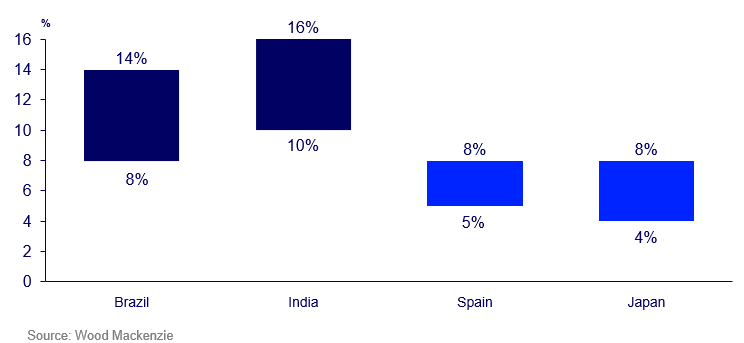
Together, these conditions can support double-digit unlevered internal rates of return (IRRs) for renewable projects with private PPAs in emerging markets. Comparable projects in developed economies may struggle to approach 10%, depending on the procurement structure.
³ Economic Research Institute, https://www.erieri.com/
⁴ IRENA Renewable Power Generation Costs
Conclusion: significant rewards await savvy investors in emerging markets
Renewable energy finance in emerging markets combines exceptional potential with a distinctive set of challenges. Multilateral development banks and DFIs have played a leading role by supplying capital and risk-mitigation support. Investors must still contend with political and regulatory uncertainty, exchange-rate volatility and infrastructure limitations.
At the same time, these regions possess some of the world's strongest renewable resources and are positioned for rapid capacity growth. Forecast investment between 2024 and 2030 totals US$1.3 trillion. Green bonds, crowdfunding and blended-finance structures are helping more projects reach completion, while PPAs and currency hedges can make the underlying risks manageable.
Growing power demand, lower development costs and first-mover opportunities can produce higher project IRRs for investors and developers. Labour and grid-connection savings are particularly important sources of value. The opportunity is not consistent across every market, however, and country risk can vary substantially. Careful market selection, diversification and the ability to adapt remain essential.
For investors and developers prepared to operate effectively in this more complex environment, the potential rewards are substantial.
Navigating these risks starts with rigorous analysis. A commercial due diligence review tests revenue, offtake and regulatory assumptions before capital is committed, while policy and geopolitical risk modelling quantifies how reforms or political shifts could move project returns. If you are assessing an emerging-market investment, speak to our team.
Keep reading
Latin America's Data Centres Will Skip Europe's PPA Mistakes
Latin America's data centre operators can learn from Europe's PPA market and move directly towards hybrid, baseload-like structures that better match round-the-clock power demand.
Why PPA adoption is accelerating in Latin America
Latin America has lagged Europe and the US on corporate PPAs despite abundant resources. Market liberalisation, hydropower volatility and currency de-risking are now changing that.